

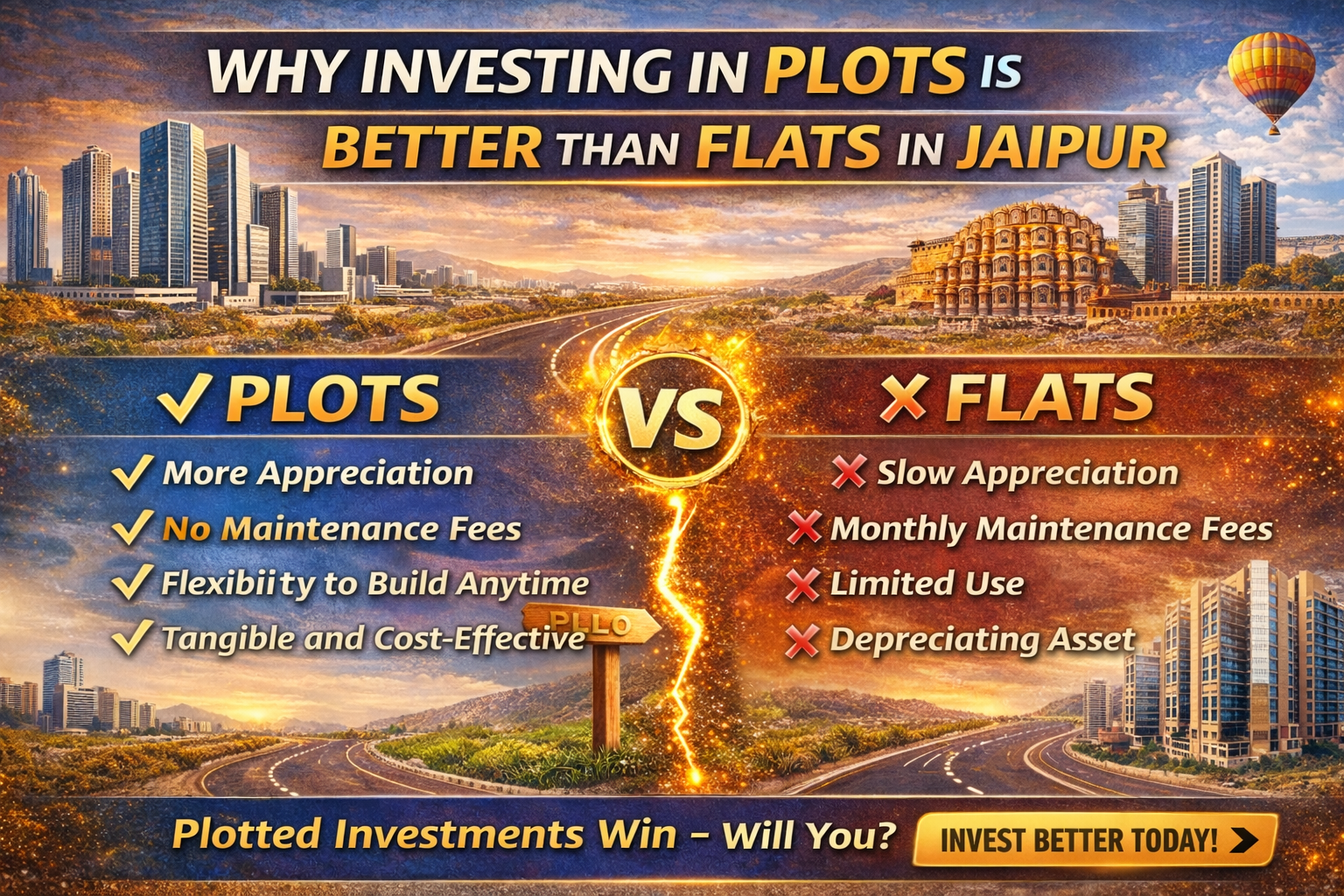
Why Investing in Plots is Better Than Flats in Jaipur
Jaipur's real estate market is undergoing a significant transformation in 2026. While flats were once considered the most secure and convenient form of property investment, a noticeable shift is now taking place. Investors are increasingly turning toward plots as a smarter, more profitable, and future-ready option.
This shift is not just a trend—it is backed by strong financial logic, market behavior, and long-term investment advantages. If you are planning to invest in Jaipur, understanding the difference between plots and flats is essential.
1. Appreciation: Land vs Structure
One of the most important factors in real estate investment is appreciation. Plots and flats behave very differently in this regard.
A flat is a constructed asset. Over time, the building starts to age, maintenance requirements increase, and the overall value of the structure begins to decline. Even if the land underneath appreciates, the depreciating building reduces the overall resale value.
On the other hand, a plot is purely land—an asset that naturally appreciates over time. Land does not suffer from wear and tear, and its value is primarily driven by location, demand, and development.
In emerging areas of Jaipur such as growth corridors and newly developing zones, land prices have shown consistent upward movement.
Plots appreciate continuously, while flats tend to depreciate after a certain period.
2. Return on Investment (ROI)
When comparing returns, plots generally outperform flats in the long run.
Flats provide relatively stable but limited growth. Their appreciation is often restricted by factors such as building age, maintenance condition, and market saturation.
Plots, however, offer exponential growth potential—especially when purchased in developing areas.
- A flat purchased for ₹40 lakh may grow to ₹50–55 lakh in 5–7 years.
- A plot purchased for ₹40 lakh in a developing area can grow to ₹70–90 lakh in the same time frame (depending on location and infrastructure development).
This difference makes plots a preferred choice for investors who are focused on wealth creation rather than just asset ownership.
3. Flexibility and Control
Flats come with predefined structures and limitations. Once you purchase a flat, you have minimal control over design, expansion, or modification.
Plots, in contrast, provide complete flexibility:
- You can build whenever you want
- You can design your home according to your needs
- You can use the land for residential or even commercial purposes (subject to regulations)
This level of control makes plots a highly versatile investment option.
Investors are not locked into a fixed structure—they have the freedom to adapt their asset according to future needs.
4. Resale Value and Liquidity
Resale is another critical factor where plots often have an advantage.
Flats tend to face challenges during resale:
- Older buildings are less attractive to buyers
- Maintenance costs discourage potential buyers
- Negotiation margins are higher
Plots, especially in developing or high-demand areas, are easier to sell. Buyers prefer plots because they can build according to their own preferences.
As a result, plots often enjoy better liquidity and faster resale opportunities.
5. Jaipur’s Expansion Favors Land Investment
Jaipur is no longer limited to its traditional city center. The city is expanding outward, with new residential and commercial zones developing rapidly.
This expansion is creating strong demand for land in emerging areas. Investors are actively targeting outskirts and growth corridors where infrastructure is improving and prices are still reasonable.
Key development drivers include:
- Road expansion and improved connectivity
- New residential townships
- Increasing population movement toward outer areas
These factors directly contribute to the rising value of plots.
6. Lower Maintenance Costs
Owning a flat comes with recurring expenses such as:
- Maintenance charges
- Society fees
- Repair and renovation costs
Over time, these costs can significantly impact your overall return on investment.
Plots, however, require minimal to no maintenance costs. There are no recurring expenses unless you choose to develop the land.
This makes plots a more cost-efficient investment in the long run.
7. Long-Term Security and Stability
Land has always been considered one of the safest forms of investment. It is a tangible asset with intrinsic value and limited supply.
Flats, on the other hand, are subject to:
- Construction quality issues
- Builder reliability
- Structural depreciation
With plots, the primary factor is location. A well-located plot in a growing area can deliver strong and stable returns over time.